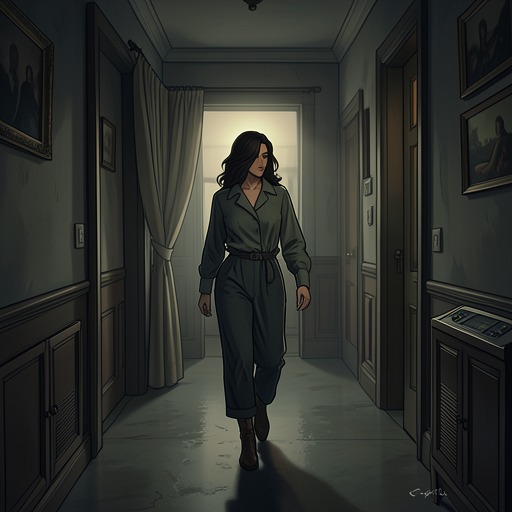
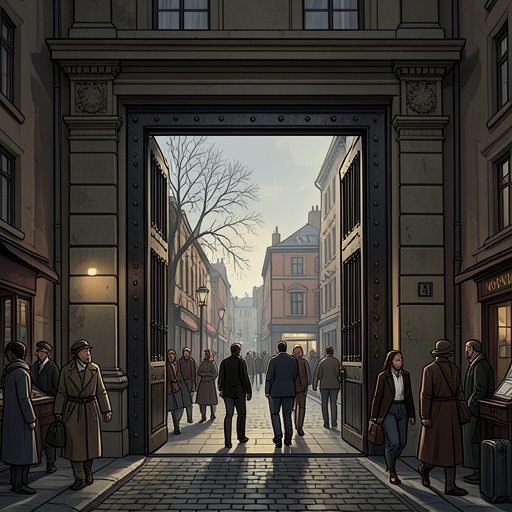
Mary escapes from the hospital
Other PeopleMary Lamb / Amy Hide’s escape from the hospital begins not with a plan but with the discovery that she is conscious, alive, and unable to recover her past. She follows an attendant toward a toilet, finds the institution’s restraints can be removed, and keeps moving until she has left its enclosed passages behind. The flight turns disorientation into action, but its freedom is precarious: outside, she runs on without knowing who she is or what awaits her, and finally hides alone, convinced that death is near.
Identity and Immediate Circumstances
At the opening of the episode, Mary Lamb / Amy Hide smells the air and feels intense gratitude. She thinks that she is all right and that time is starting again, but the return of consciousness has not restored her identity. The first-person thought is an isolated sign of awareness rather than a recovered memory: she can register her present condition while remaining unable to connect it to a personal history. Her eyes fill with water, and she closes them when she cannot manage it. The scene establishes the escape’s central imbalance: her body is awake and responsive, while the past that might explain her circumstances remains inaccessible.
An attendant comes close and asks whether she is all right. Mary Lamb / Amy Hide nods and answers that she is. When he later asks whether she needs the toilet, she accepts the practical opportunity, though without much hope. The exchange is brief and ordinary beside the extremity of her confusion. She does not begin by challenging the institution or articulating a destination; she uses the immediate opening presented by the attendant’s movement. That small decision becomes the first step in a larger departure.
From Confinement to the Exit
As she tries to follow the attendant, Mary Lamb / Amy Hide discovers heavy, curved extensions attached to her feet. They make movement difficult, seemingly to the point of preventing it. She nevertheless approaches him, unsteadily, and is led into a passage. There she sees white-clad keepers and other people, some smaller and bound in varied robes, being carried or guided. She recognizes herself as belonging among these vulnerable, dependent figures, although she cannot explain why she is there. Her surroundings offer visible evidence of confinement but no account of its cause.
In the narrow toilet room, she searches her mind for clues and finds nothing. A polished square of steel briefly reflects a startled, dark-haired figure who looks back at her and ducks away. Mary Lamb / Amy Hide cannot tell whether other people are frightened or whether her own presence is the source of fear. She also cannot know how long she is expected to remain in the room. The possibility of being left there indefinitely sharpens her uncertainty; for a moment she considers whether the world itself is only her idea, before recognizing that its apparent threat makes little sense to her.
She solves the door’s mechanism and comes out after the attendant has gone. Without pausing, she moves in the direction of the keepers and their slower charges, following light along the walls. The passage opens into a crowded area where people stand in distress or lie on tables while staff move others away. A blood-covered person is shouting, and the double doors beyond admit air and light. Mary Lamb / Amy Hide skirts the surrounding confusion. No one stops her, and she reaches the doors.
Removing the Restraints and Running
The devices on Mary Lamb / Amy Hide’s feet impede her again when she tries to accelerate along the glass passage. She examines them and discovers that they can be removed without much difficulty. Two men carrying an empty hammock shout at her and gesture toward the discarded devices, but she continues out. The escape therefore depends on a practical discovery rather than on the restraints simply failing: the apparatus that had made movement painfully difficult is detachable, and she chooses to leave it behind despite the men’s objection.
Outside, the change is initially one of scale rather than immediate safety. People still move through high, covered passages, while those seeking greater speed and noise use crowded trolleys in the central lanes. Many people look at Mary Lamb / Amy Hide and at her bare feet; she understands that people are expected to have devices like the ones she has discarded. She regards this as her first mistake and feels sorry, but she does not turn back. Her passage into the wider world is thus marked by both increased freedom and the continued pressure of rules she cannot understand. No one intervenes, and she joins the moving human traffic.
After deciding to get the surrounding circumstances over with, she realizes that she is running. Running pleases her and gives her the first clear, urgent prompting she has experienced. The passages recede; people turn, and some call after her. One person follows clumsily for a while, but she moves ahead and finds that she can run as fast as she likes. She believes speed will save time and make the next event arrive sooner. Movement is at once a bodily capacity, a source of immediate satisfaction, and her improvised answer to an unknown future.
Beyond the Enclosure
Mary Lamb / Amy Hide eventually reaches an area without people, where the concrete ends and green land rises beyond spiked rods. She notices red creatures beneath a patterned roof and a silver presence in the dark above. A gap in the enclosure opens onto a lane marked by a horizontal white bar. She bends beneath it and runs over the soft ground. The route is specific and physical: she passes from built, monitored passages through an opening in a barrier and into land where she can hide.
She finds a moist hollow at the foot of a leaning tree and curls up there, breathing unevenly. She believes this is her death. Pain she has carried throughout the day overwhelms her, and she cannot keep herself from making sounds; she tries to be quiet because she is hiding. As the shadows deepen, the ground seems to receive her. At the last moment, the air appears to hum, and points of light go out one after another above her. The narration leaves the meaning of this final perception unresolved. It records Mary Lamb / Amy Hide’s conviction that she is dying, not a confirmed death or a clear explanation of the lights.
Consequences and Narrative Significance
The escape changes Mary Lamb / Amy Hide’s immediate position without supplying the missing knowledge that would make her circumstances intelligible. Inside, attendants, restraints, and crowded rooms define her as someone to be managed; outside, she can remove the devices, choose her direction, and outrun those who follow. Yet her freedom does not become secure arrival. She does not know the institution’s purpose, the reason for her confinement, or the identity of the people around her, and the episode ends with her alone in hiding.
The sequence makes bodily action precede explanation. A nod, an attempt to follow, the removal of the foot devices, and the decision to run carry her farther than her fragmentary understanding can. The repeated movement from room to passage, from doors to streets, and from concrete to open land gives the escape its forward momentum, while the final retreat into the hollow reverses that outward flight. She gets beyond the enclosure, but not beyond fear or pain. The episode therefore establishes both the force and the limits of her first act of self-directed movement.